

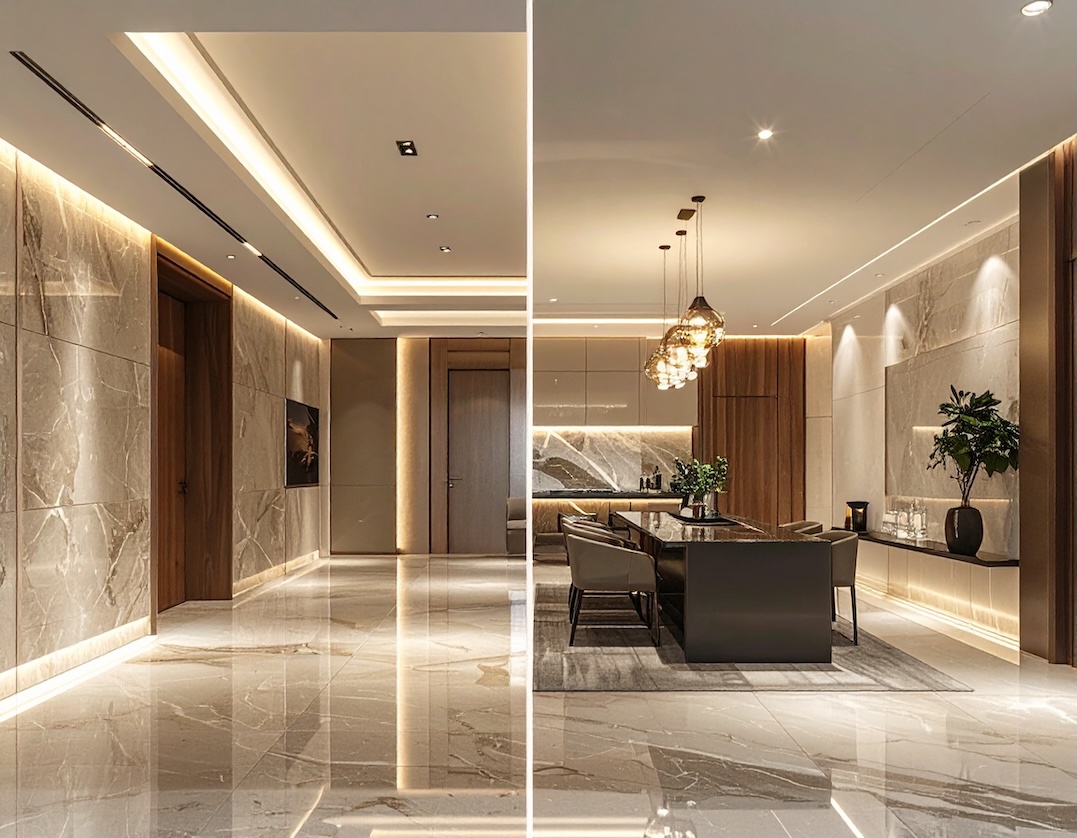
Lighting is one of the most influential elements in interior design, yet it is often misunderstood. Many people associate lighting solely with decorative fixtures, but truly successful spaces rely on a careful balance between architectural lighting and decorative lighting. Understanding the distinction is essential for creating interiors that are both visually compelling and highly functional.
1. Architectural Lighting Shapes the Space Itself
Architectural lighting is integrated into the built environment. Recessed profiles, concealed coves, wall washers, and indirect lighting are designed to reveal form, texture, and spatial depth. Rather than drawing attention to the fixture, architectural lighting focuses on enhancing the architecture.
2. Decorative Lighting Creates Visual Identity
Decorative lighting serves as a design statement. Chandeliers, pendants, sconces, and feature fixtures act as focal points that contribute personality, brand expression, and aesthetic character. Their impact is often emotional rather than purely functional.
3. One Illuminates Surfaces, the Other Illuminates Perception
A well-designed space is not measured by brightness alone. Architectural lighting controls how materials, proportions, and transitions are experienced, while decorative lighting influences how occupants emotionally connect with the environment.
4. Layering Creates Premium Interiors
Luxury spaces rarely depend on a single lighting strategy. The most sophisticated interiors combine concealed architectural lighting with carefully curated decorative fixtures, creating depth, hierarchy, and visual comfort.
Looking Ahead
The future of interior lighting is increasingly integrated and experience-driven. While decorative fixtures continue to make bold design statements, architectural lighting remains the invisible framework that defines how a space feels. The most successful interiors understand that great lighting is not about choosing one over the other—it is about knowing when each should take the lead.


 Chat with us now!
