

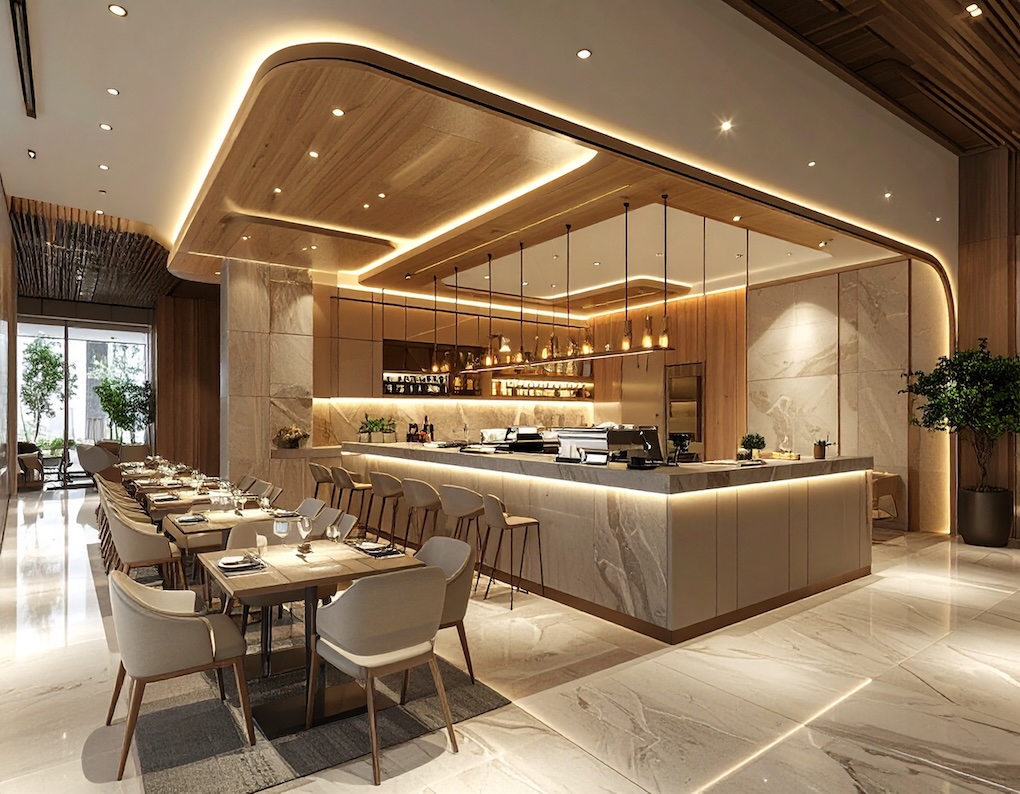
Successful restaurant interiors are no longer designed solely for opening day. In an industry where growth often means additional outlets, larger footprints, or new service formats, future-ready interior planning has become a strategic business decision. The most scalable restaurants are designed with expansion in mind from the very beginning.
1. Creating a Replicable Design DNA
Rather than designing every element as a one-off feature, successful brands establish a clear design language that can be replicated across future locations. Signature materials, lighting concepts, seating styles, and spatial cues help create consistency while simplifying future rollouts.
2. Infrastructure That Anticipates Growth
Forward-thinking restaurants incorporate oversized electrical capacity, adaptable HVAC systems, and flexible plumbing provisions during the initial fit-out. These hidden investments reduce disruption and costs when kitchens expand, technology upgrades are introduced, or service models evolve.
3. Designing for Multiple Revenue Channels
Future expansion is not always physical. Restaurants increasingly grow through delivery, take-away, cloud kitchen operations, and retail product sales. Interior layouts that accommodate dedicated pick-up zones, packaging stations, and flexible service counters support evolving business models.
4. Modular Spaces That Scale with Demand
Fixed layouts can quickly become limitations. Modular seating systems, movable partitions, and adaptable dining zones allow restaurants to accommodate changing customer volumes, private events, and operational requirements without extensive renovations.
5. Building Brand Recognition Through Spatial Memory
The most successful restaurant brands create memorable spatial experiences that customers instantly recognize. Distinctive entry sequences, lighting moments, material transitions, or feature installations become scalable brand assets that can be carried across future locations.
Looking Ahead
Restaurants that plan for expansion from day one create more than attractive dining environments—they build scalable business platforms. Strategic interior planning enables brands to grow faster, maintain consistency, and adapt to future opportunities without compromising customer experience.
 Chat with us now!
